

As 3D printing elastic resins move toward mass production, companies are increasingly focused on one question: how can they achieve both high performance and low cost?
In the past, two-component (2K) resins became an important choice for high-performance elastic 3D printing materials because of their excellent elasticity, flexural resistance, and tear resistance. At the same time, they involve complex operation, high labor costs, and material waste caused by easy gelation.
By comparison, one-component (1K) resins are simpler: they are ready to use directly from the container, require no on-site mixing, are more convenient during printing, and are easier to recover and reuse. More importantly, as material technology continues to advance, the mechanical performance of some next-generation 1K elastic resins is becoming increasingly close to that of traditional 2K systems. How should companies choose between a quality benchmark and commercial cost reduction? Next, we will comprehensively break down the technical mechanisms, mechanical performance, and cost-reduction calculations of 1K and 2K systems, and reveal how advanced one-component resins can be implemented in mass production.
01 Looking Back: Three Stages in the Evolution of 3D Printing Elastic Resins
Stage One: Pure Photocuring System (Single Network)
In the early stage, photocurable 3D printing elastic resins mainly provided flexibility and were mostly based on free-radical acrylate systems. They are now widely used in figurines, dentistry, and other fields.
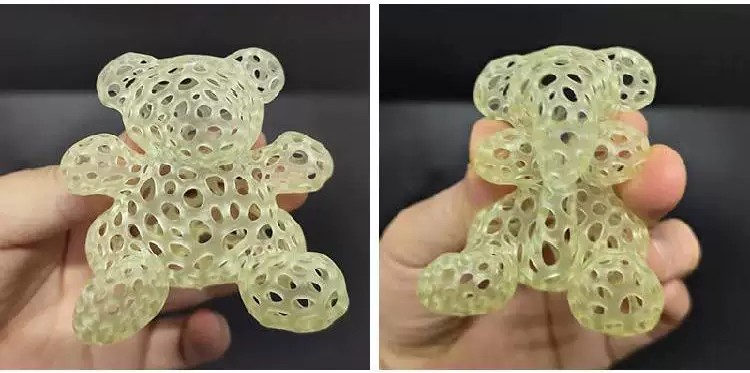
Critical defects: the network structure formed by photocuring has a high crosslink density but lacks a phase-separated soft/hard segment structure. This results in poor rebound, low tear strength, and easy deformation under tension.
Stage Two: Two-Component Resin System
To address the performance limitations of first-generation materials, the industry introduced a thermally cured polyurethane/polyurea (PU/PUa) hard-segment network to construct a dual-curing topological network.
First stage (photocuring): UV exposure rapidly crosslinks the acrylate double bonds to form a green body with a certain level of strength and determine its geometry. This step is mainly responsible for printing the product.
Second stage (thermal curing): the green body enters an oven, where the deblocked isocyanate (-NCO) in the prepolymer undergoes step-growth polymerization at high temperature with polyamines such as PACM or polyols in Component B, forming rigid polyurea/polyurethane hard segments rich in hydrogen bonds.
It can be understood simply as follows: the first curing stage forms the part, and the second curing stage reinforces it.
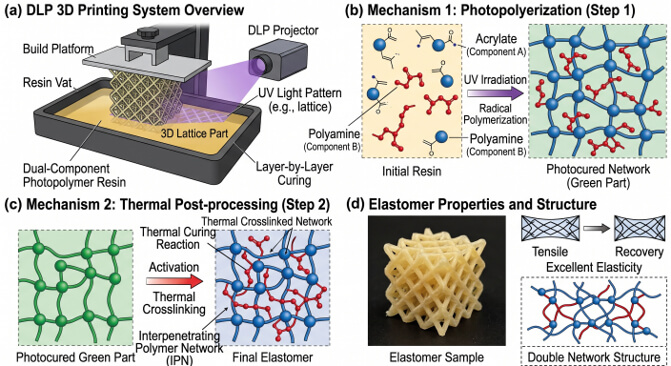
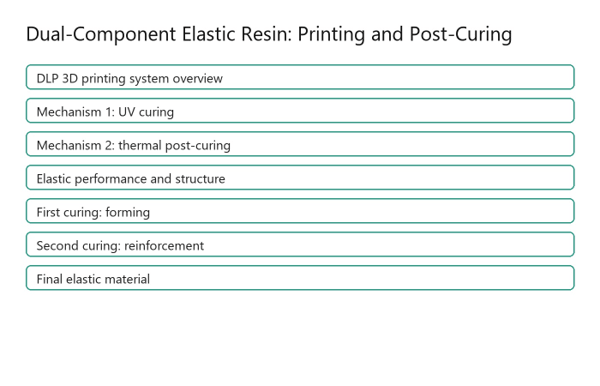
Result: material performance achieved a qualitative leap. Flexural fatigue testing easily exceeded 100,000 cycles, with a rebound rate above 30%, giving 3D printing elastic resins a foundation for functional applications for the first time.
Defects: mixing is required before use, the usable period is limited by resin pot life, and cured residual material causes waste.
Stage Three: Oxygen-Permeable Ultra-High-Speed Printing (CLIP/DLS)
The leap from being printable to being mass-producible. High-performance materials alone are not enough. The traditional layer-by-layer peel-release method is extremely slow, and the release force can easily damage elastic resin green bodies with relatively low strength. Carbon was the first to develop CLIP technology, achieving ultra-high-speed printing by creating an oxygen-permeable dead zone without release force.
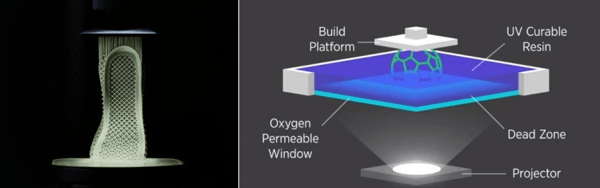
Technical features: an oxygen-permeable membrane, such as a fluoropolymer membrane, is introduced, while oxygen is supplied beneath the membrane to form a micron-scale oxygen dead zone. Oxygen inhibits free-radical polymerization, preventing formation in the dead zone, greatly reducing release force and enabling continuous liquid-surface growth.
Mass-production breakthrough: physical peeling force between layers is eliminated, increasing printing speed by several to dozens of times while giving the finished products excellent isotropy. The combination of oxygen-permeable ultra-high-speed printing and two-component resin has truly opened the era of large-scale industrial production of 3D printed soles.
02. The Engineering Reality of 2K Systems and the Introduction of 1K Technology
Although 2K (two-component) dual-curing systems have made significant breakthroughs in mechanical performance, their practical use in large-scale industrial production also brings clear engineering and operational constraints.
Engineering constraints of 2K systems in mass production
Mixing bottleneck: Components A and B must be precisely metered and mixed at high speed. This places extremely high accuracy requirements on two-component mixing pumps; a power outage or equipment failure can waste an entire batch of material.
Extremely short resin life: after Components A and B are mixed, slow gelation begins at room temperature. Resin life is usually only 4-12 hours. Unused resin is very likely to be scrapped in the vat, causing substantial material waste.
Extremely high operating threshold: printing interruptions and difficult cleaning make the system unsuitable for continuous large-scale factory operation.
Background to the introduction of 1K one-component dual-curing systems
To simplify material preparation and extend resin stability in the vat, one-component (1K) multi-curing technology was developed. Its core concept is to lock active groups at room temperature through molecular chemical blocking or latent crosslinking mechanisms:
In the vat (room temperature/no water): the material is photosensitive but inert to heat and moisture, with a shelf life of several months or even more than one year. It is ready to use directly from the container with zero waste.
After printing (post-processing stage): under specific conditions in a temperature-and-humidity chamber or dry oven, the green body undergoes deblocking and chain extension to rebuild the high-strength polyurethane/polyurea topological network.
03. Technical Comparison of 1K and 2K Systems
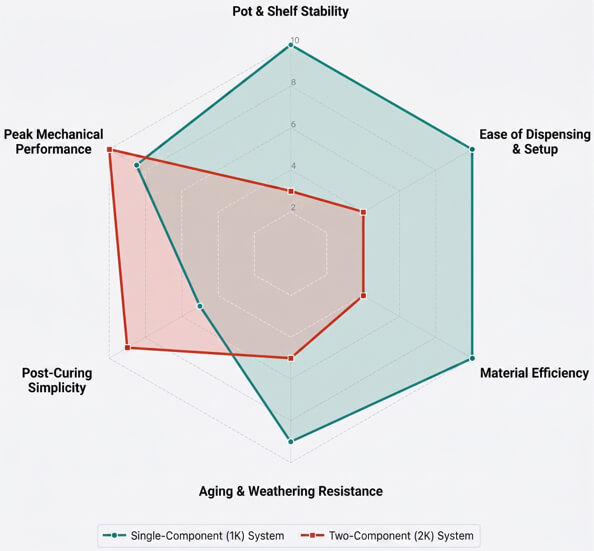
To comprehensively evaluate the feasibility of the two systems in industrial applications, we can make an objective comparison across three dimensions: chemical reaction mechanisms, physical performance, and process requirements.
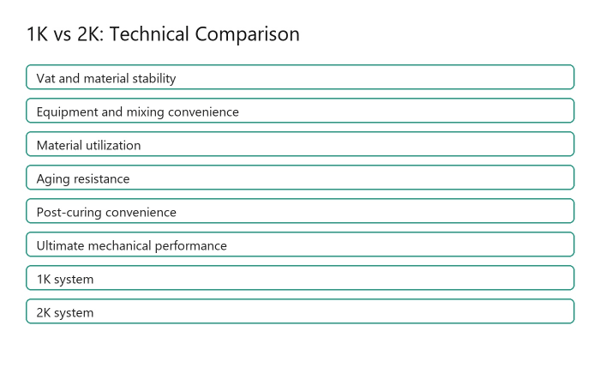
Comparison dimension; 2K; 1K; Industrial mass-production impact
Shelf life; Short (six-month sealed shelf life, generally 4-12 hours in an open system); Very long (one-year sealed shelf life, generally more than three months in an open system); 1K resin avoids material waste caused by short shelf life and resin becoming unprintable
Material preparation; Requires a high-precision 2K automatic mixing and feeding system; Ready to use directly, no mixing required; 1K resin reduces labor for preparation and time spent cleaning the vat
Equipment requirements; High equipment requirements, generally suited to oxygen-permeable peel-up DLP printing; Compatible with LCD/DLP, both bottom-up and top-down configurations.
1K resin lowers the usage threshold and facilitates batch validation
Material utilization; Poor (residual resin in the vat and lines gels easily); 100% (unprinted resin can be separately recovered and reused); Centrifugally recovered resin can be directly reused.
Post-curing process; Simple, generally 120°C for 8 hours; Relies on moisture or latent-amine chain extension and may take longer; 1K requires a more precise post-curing process
Support removal; Requires prolonged manual cutting after post-curing; Supports can be removed immediately after printing; 1K can save substantial labor
Hardness; Generally distributed above 65A; Above 30A; 1K resin has a wider application range
Mechanical performance; Excellent; Very good; 2K resin has a structural advantage
Aging resistance; Average; Excellent; 1K resin performs relatively well in aging resistance
04. iSUN3D FlexOne One-Component Resin: Solution and Commercial Value
Core technical advantages (compared with the industry)
Compared with traditional 2K systems and other ordinary 1K products on the market, iSUN3D’s solution demonstrates clear technical and engineering advantages:
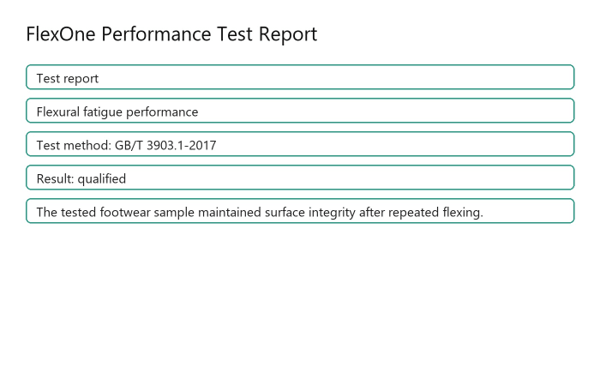
Performance approaching the 2K benchmark: through proprietary latent reconstruction technology, products easily exceed 100,000 flexural fatigue cycles, with tear strength above 30 kN/m, completely breaking the industry’s prejudice that 1K resin breaks easily.

A very wide production process window: the resin has moderate viscosity and good flowability at room temperature and can be stored for more than 12 months under sealed conditions. It is ready to use directly from the container, and its viscosity and performance remain stable even during long-term cyclic printing in an open vat.
Top-Down: excellent stability and convenience can be used for large-format bottom-up industrial manufacturing, enabling genuine mass production.
Automated production: efficient automated production can be achieved through automated material replenishment.
Commercial value of cost reduction and efficiency improvement
For 3D printing service providers, footwear companies, and industrial manufacturers, adopting the iSUN3D one-component elastic resin solution can bring direct and quantifiable financial and operational returns:
Dimension; Traditional 2K solution; iSUN3D one-component solution; Commercial value and cost-saving assessment
Equipment investment; Requires expensive printing equipment and a high-precision 2K mixing and feeding system; No modification required and directly compatible with standard DLP/LCD printers; Hardware procurement costs decrease by 40%-60%
Material loss; Residual resin in lines and the vat gels at room temperature, resulting in a high waste rate; 100% recovery and reuse, with unprinted resin recoverable; Overall resin material loss decreases by 15%-20%
Operations and maintenance; Mixing valves clog easily, cleaning is frequent, labor costs are high, and equipment must be fully shut down for cleaning during holidays; Ready to use directly, with no risk of line blockage and very short shutdown cleaning time; Equipment operation and maintenance costs decrease by 10%-20%
Delivery flexibility; Switching resin requires cleaning the entire 2K system, slowing small-batch response; Fast material changes by container, suitable for multiple hardness levels and styles; Delivery cycles for small-batch/customized orders are shortened 20%-30%
Automation; Mixing, feeding, vat cleaning, and support removal require substantial labor; Supports can be removed after printing; Labor requirements decrease by 10%-20%
Mature industry application solutions
At present, the iSUN3D one-component dual-curing elastic resin solution has been validated for mass production in multiple demanding industrial and consumer scenarios:
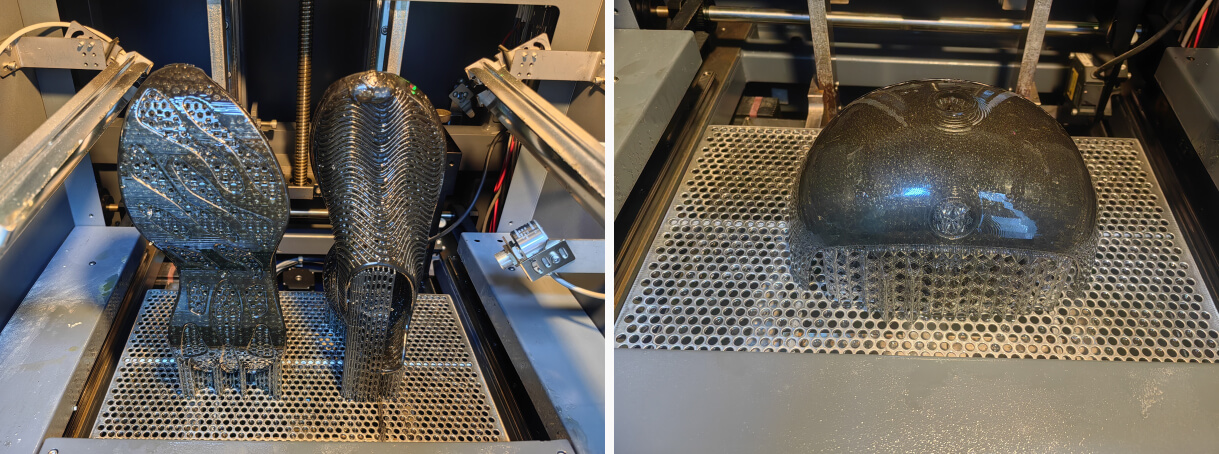
1. Footwear manufacturing (midsoles/printed shoes/orthotic insoles): compatible with complex Voronoi and Gyroid topological lattice designs, providing soles with excellent underfoot feel, support, and exceptionally long flexural fatigue life, while helping footwear companies significantly shorten new-shoe mold development and rapid-response cycles.
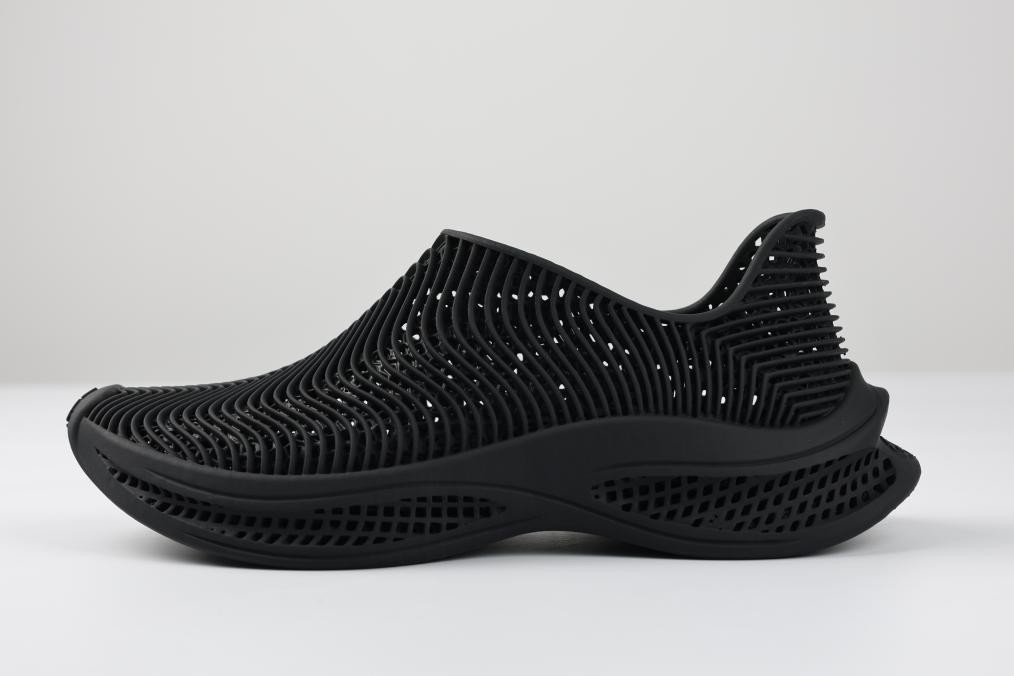
iSUN3D one-component elastic resin 3D printed shoe
2. Cushioning and comfort support (cycling/rehabilitation): used to manufacture bicycle saddles, wheelchair cushions, and other products. Lattice structures provide lightweight construction, cushioning, shock absorption, and comfortable support while balancing breathability and durability.
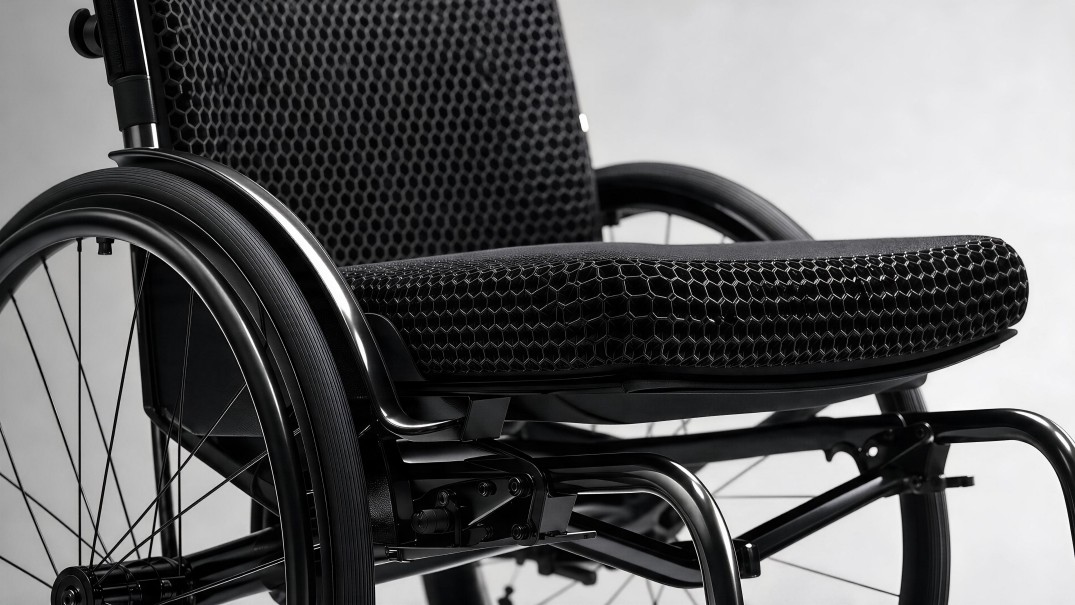
3D printed elastic resin lattice wheelchair cushion
3. Healthcare and flexible tendon skins (medical/humanoid robots): used for personalized medical rehabilitation braces, soft prosthetic liners, and tendon skins for humanoid robots, providing a safe and durable flexible touch.
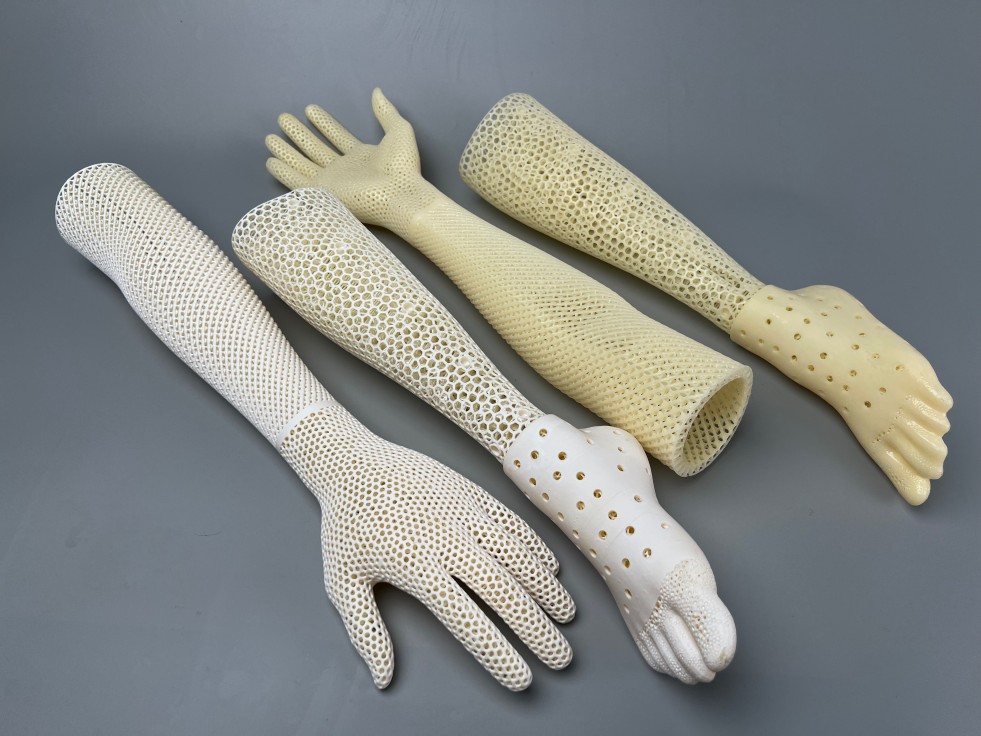
iSUN3D humanoid robot arm and leg samples
Conclusion: choosing a material is essentially choosing a manufacturing method
From the early ability to print flexible parts, through the high-performance breakthrough brought by 2K dual curing, to the renewed optimization of mass-production efficiency and total cost enabled by 1K technology, the development of 3D printing elastic resins has always revolved around three questions:
1. Can the performance meet real-world use?
2. Can the process be reproduced consistently?
3. Can the cost support large-scale production?
Through a carefully designed molecular blocking and latent crosslinking structure, iSUN3D’s FlexOne one-component multi-curing system significantly improves the engineering pain points of traditional 2K systems, including short vat life, high waste rates, and complex equipment.
It offers strong commercial value in equipment investment, material loss, operations and maintenance, delivery flexibility, and automation. FlexOne provides enterprises with a more flexible manufacturing path for soft and elastic products, while creating new possibilities for photocurable elastic resins to enter larger-scale industrial applications.